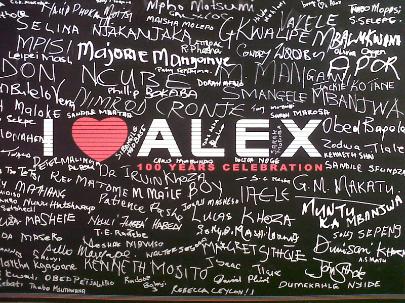
History•Alexandra or Alex for short, described by Nelson Mandela as “exhilarating and precious” is a township located in Johannesburg which is located close to Sandton and is bounded by Wynberg on the west, Marlboro and Kelvin on the north, Kew, Lombardy West and East on the south. •Alex is situated on the banks of the Jukskei River and covers an area of more than 8 km2. It has a current estimated population of 470 000 people of which a large number lives in informal dwellings. •Alex was established in 1912, on land originally owned by a farmer, a Mr. H.B Papenfus who named the township after his wife Alexandra. It was one of the few urban areas in the country where blacks could own land under a freehold title. •In the early 1960’s, the government decided to demolish all family homes in Alex and replace them with single-sex hostels, which led to widespread resistance and protest. Rev Sam Buti led the resistance through his ‘Save Alexandra Party’. Only two hostels were actually completed, and the scheme was cancelled in 1979 •In 1980 a "Master Plan" for Alexandra was introduced, which aim was to transform Alexandra into a "Garden City" with a completely new layout. However, only a small part of this plan was actually ever implemented; the execution of the "Master Plan" was permanently stopped by the violent "Alex Six Days" uprising in February 1986, during which 40 people were killed. By May the council started collapsing and the councilors resigned which saw the emergence of street committees and peoples' courts. •After the imposition of the nationwide state of emergency in June, the Defence Force moved in to keep the peace. In its place, the government introduced the "Urban Renewal Plan" as part of its strategy during the state of emergency. •However, this plan lead to considerable demolitions, disruptions and displacement in the community as well as two treason trials involving 13 leaders of Alexandra. The “Urban Renewal Plan” was shelved in 1990. • During the communal and political conflicts that took place in the 1991 - 1992 period, many people were killed, injured or displaced. Violence broke out between residents in the men's hostels and residents just south of the hostels, an area that became known as "Beirut". • In early 1992 some 60 people were killed and nearly 600 people were injured and around 10 000 people were displaced from their homes.This led to several peace initiatives, which were greatly assisted by the first fully democratic South African elections in April 1994. Notable residents of Alexandra included: • Nelson Mandela (Former President of the Republic of South Africa) • Kgalema Petrus Motlanthe (Deputy President of the Republic of South African • Zanele Mbeki (Wife of former President Thabo Mbeki) • Mark Mathabane (Tennis player and author of the autobiography Kaffir Boy) • Samora Machel (Former Mozambique president) • Alfred Nzo (South African Minister of Foreign Affairs 1994-1999 Notable residents of Alexandra included: •Joe Modise (South African Minister of Defence 1994-1999) •Leepile Taunyane(Acting Chief Executive Officer & Life President PSL) •Hugh Masekela (Musician and trumpeter) •Jack 'Big Voice' Lerole (Musician and penny-whistle player) •Wally Serote (Poet) •Thami Mnyele (Artist/activist) •Annie Twala (the "Mother of Alexandra") •Simon Mahlathini Nkabinde (Lead singer in Mahlathini and the Mahotella Queens, 1938–1999) •Irvin Khoza (Sports administrator) •Lesetja Kganyago •Paul Mashatile (South African Minister of Arts & Culture) •Nkuli Habedi (Rapper) •L- Tido (Artist) •Zanele Mbeki •Tito Mboweni •Lesego Kganyago
Testimonials"This is sample testimonial from a sample source." -- Sample Client, Location "This is another sample testimonial from another sample source." -- Sample Client, Location |
||||